If you’ve just started trading, taken on your first contract, or set up a limited company, there’s a good chance you’ve asked yourself the same question dozens of other UK business owners ask every year: “Do I need to file a Self Assessment tax return, a Corporation Tax return, or both?” It’s a genuinely confusing area, and getting it wrong isn’t a small mistake — it can mean missed deadlines, unexpected HMRC penalties, and interest piling up on tax you didn’t even know you owed. If you’re lying awake wondering whether you’ve registered for the right thing, you’re not alone, and this guide will clear it up for good.
📱 Not sure which tax return applies to you? Get a free answer in minutes.
The Short Answer: It Depends on Your Business Structure
The single biggest factor that determines which tax return you need is how your business is legally structured. In simple terms:
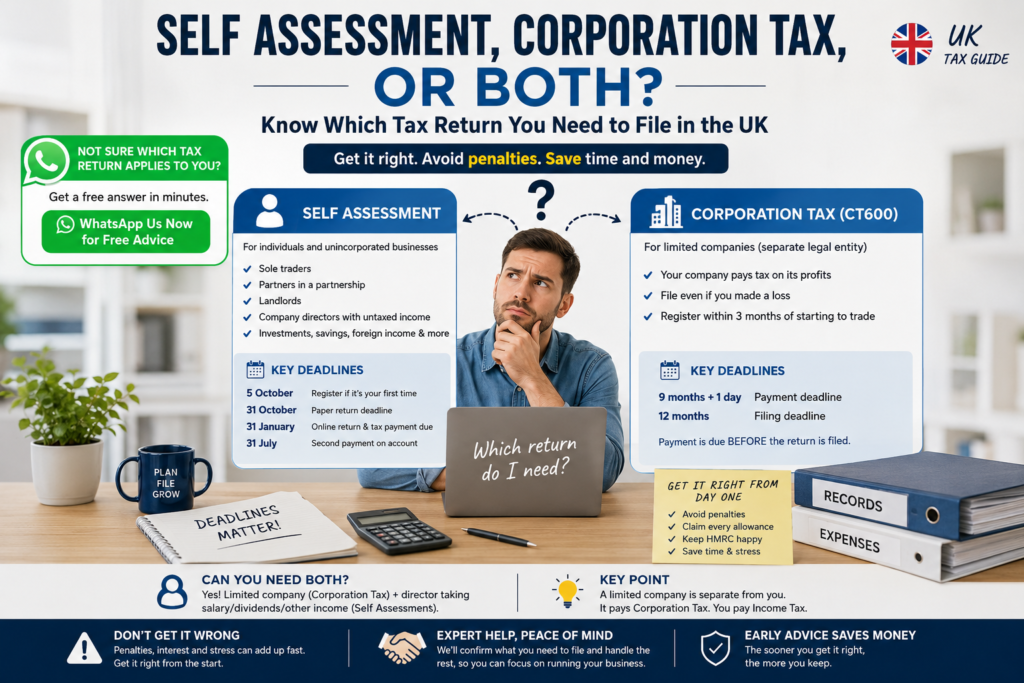
- Sole traders and individuals (including partners in a partnership, landlords, and company directors with untaxed income) file a Self Assessment tax return.
- Limited companies file a Corporation Tax return (CT600), completely separate from any personal tax return the director might also need to file.
Many small business owners running a limited company are surprised to learn they may need to file both — a Corporation Tax return for the company, and a Self Assessment return for themselves personally, especially if they take dividends or additional income outside PAYE.
Key Point: A limited company is a separate legal entity from you. It pays its own tax (Corporation Tax) on its profits. You, as a director or shareholder, are taxed personally (via Self Assessment or PAYE) on what the company pays you.
Self Assessment: Who Needs to File One?
Self Assessment is HMRC’s system for collecting Income Tax and National Insurance from people whose income isn’t automatically taxed through PAYE. You’ll typically need to register for Self Assessment if you are:
- A sole trader with self-employment income over £1,000 in a tax year
- A partner in a business partnership
- A landlord earning rental income
- A company director who receives dividends, benefits in kind, or other untaxed income
- Someone with significant savings, investment, or foreign income
- Someone who needs to claim certain reliefs, such as higher-rate pension tax relief
Key Self Assessment Deadlines
Missing these dates is one of the most common (and most avoidable) ways small business owners end up with unnecessary HMRC penalties:
- 5 October — Deadline to register for Self Assessment if it’s your first time
- 31 October — Paper return deadline
- 31 January — Online return deadline, and the date any tax owed must be paid
- 31 July — Second payment on account, if applicable
Missing the 31 January deadline triggers an automatic £100 penalty even if you owe no tax, with further daily penalties and interest the longer it’s left unresolved. If you’re unsure whether you fall within Self Assessment, our tax preparation services can quickly confirm your position and get you registered correctly.
What You’ll Need to Report
A Self Assessment return covers your total income from all sources in a tax year (6 April to 5 April), including self-employment profits, rental income, dividends, savings interest, and any capital gains. You’ll also declare allowable expenses and reliefs that reduce your tax bill.
Corporation Tax: Who Needs to File a CT600?
If you trade through a limited company, the company itself is legally required to file a Corporation Tax return, regardless of whether it made a profit or a loss. This applies from the moment the company starts trading, not from when it becomes profitable.
Current Corporation Tax Rates
For company profits, the current UK Corporation Tax structure is tiered:
- 19% small profits rate — applies to profits up to £50,000
- 25% main rate — applies to profits above £250,000
- Marginal relief — tapers the effective rate for profits between £50,000 and £250,000
These thresholds are reduced if your company has associated companies under common control, so groups of connected businesses should take advice before assuming the small profits rate applies.
Key Corporation Tax Deadlines
- Payment deadline — 9 months and 1 day after your company’s accounting period ends
- Filing deadline — 12 months after the end of the accounting period
Note that payment is due before the return itself needs to be filed, which catches many new company directors off guard. HMRC charges interest automatically on late payments, and penalties escalate the longer a return remains outstanding. Full, current guidance is available on the official HMRC Corporation Tax pages.
Registering for Corporation Tax
You must register your company for Corporation Tax with HMRC within 3 months of starting to trade. This is separate from registering the company at Companies House, and it’s a step that’s surprisingly easy to overlook amid everything else involved in launching a business.
Can You Need Both Returns at Once?
Yes — and it’s more common than most new directors expect. A typical example: you run a limited company (so the company files Corporation Tax) and you’re also a director who takes a salary plus dividends. If your dividend income exceeds the dividend allowance, or you have other untaxed income, you’ll personally need to file a Self Assessment return too, in addition to the company’s Corporation Tax return.
Key Point: Sole traders never file Corporation Tax — there’s no legal separation between you and your business. Limited company directors almost always need to think about both the company’s Corporation Tax and their own Self Assessment.
Sole Trader or Limited Company — Which Suits You?
If you’re still deciding how to structure your business, the tax return question is only one part of a wider decision involving liability, administration, and long-term tax efficiency. Our team regularly helps clients weigh up the right structure for their circumstances before they commit.
What Happens If You File the Wrong Return, Late, or Not at All?
HMRC penalties escalate quickly and apply separately to Self Assessment and Corporation Tax:
- An immediate £100 fixed penalty for late Self Assessment filing, even at one day late
- Daily penalties of £10 after three months, up to £900
- Further penalties at 6 and 12 months, calculated as a percentage of tax owed
- Interest on Corporation Tax paid late, charged automatically from the payment deadline
- Corporation Tax penalties starting at £100 and increasing the longer a return is overdue, with larger penalties for persistent lateness
If you’ve fallen behind on either return, the earlier you act, the more options you typically have to reduce the damage. HMRC is generally more sympathetic to businesses that come forward voluntarily than those found through compliance checks.
Why It Pays to Get This Right From Day One
Getting your tax registrations right from the start of trading isn’t just about avoiding penalties — it also means you claim every allowance and relief you’re entitled to, keep clean records HMRC won’t query, and avoid a stressful scramble each January or at your company’s year end. Whether you’re a sole trader weighing up whether to incorporate, or a new limited company trying to understand your first set of filing obligations, professional guidance pays for itself many times over in the peace of mind and money it saves. Learn more about how we support small businesses like yours on our about page.
Frequently Asked Questions
Do sole traders ever pay Corporation Tax?
No. Sole traders are not legally separate from their business, so all business profits are taxed through Self Assessment as personal income, not Corporation Tax.
Does a limited company director need to file Self Assessment as well as Corporation Tax?
Often, yes. The company files Corporation Tax on its profits. The director personally files Self Assessment if they receive dividends above the dividend allowance, benefits in kind, or other untaxed income.
What happens if my company makes a loss — do I still need to file Corporation Tax?
Yes. A Corporation Tax return is still required even in a loss-making year, and filing it correctly allows you to carry the loss forward or back to reduce tax in other years.
Can I switch from Self Assessment to Corporation Tax during the year?
If you incorporate a sole trader business into a limited company partway through the year, you’ll file a final Self Assessment return covering your sole trader income up to incorporation, and the new company becomes responsible for Corporation Tax from that date onward.
Where can I get help deciding which return applies to me?
Our team can review your situation and confirm exactly what you need to register for and file. Get in touch via our contact page or WhatsApp us directly for a free initial chat.